
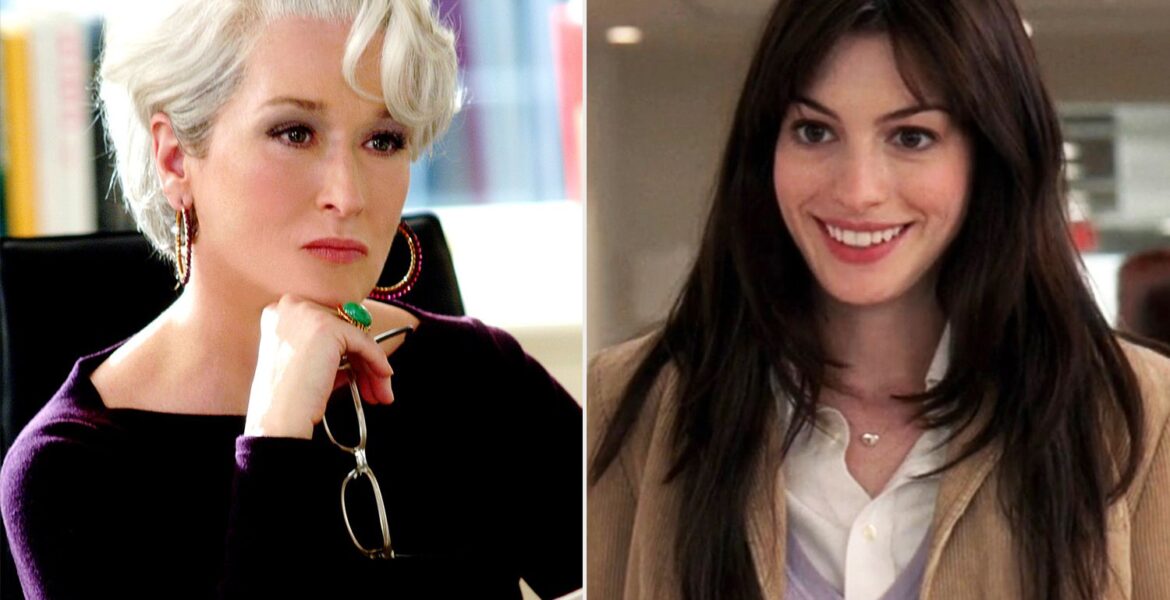
For women in the mid-2000s, The Devil Wears Prada wasn’t just a movie—it was a career mood board. The outfits, the ambition, the idea of making it in New York—it all felt aspirational. And to be clear, it’s still wildly entertaining. Meryl Streep’s performance as Miranda Priestly remains iconic for a reason. So with the sequel set to drop this weekend and with so much time having passed since I watched the original, I decided to watch the original film again.
It was an eye-opening and interesting experience. Watching it now, nearly two decades later, the film lands… differently. What once felt sharp and glamorous now raises real questions about workplace culture, representation, and how women are framed in positions of power.
Here’s what doesn’t quite hold up—and why.
1. Body Shaming as Workplace Culture
Emily Charlton’s obsession with thinness isn’t just a character quirk—it’s baked into the culture of Runway. The casual cruelty around body size (“I’m one stomach flu away from my goal weight”) and the infamous “smart fat girl” line position thinness as a prerequisite for competence and belonging.
Today, in an era of body neutrality and ongoing conversations around disordered eating, those moments don’t read as witty—they read as normalized harm.
2. The “Ice Queen” Female Boss Trope
Miranda Priestly is powerful, brilliant, and exacting—but the film frames much of that power through emotional coldness and intimidation. Her authority is expressed via fear.
That trope—the hyper-successful woman who must be ruthless to survive—feels dated now. We’ve seen plenty of examples of strong leadership that don’t rely on humiliation as a management strategy. The film never really interrogates that—it just packages it as the cost of excellence.
3. Career vs. Love as a False Choice
At its core, Andy’s arc suggests a binary: succeed in your career or keep your relationship. As Andy Sachs rises professionally, her personal life deteriorates—culminating in the idea that she must choose who she is.
That framing feels overly simplistic. Today’s conversations around ambition are far more nuanced, recognizing that fulfillment isn’t a zero-sum game between love and success.
4. Toxic Work Culture Played for Comedy
Impossible demands. Late-night errands. Public humiliation. In the film, these are often played for laughs—or positioned as rites of passage.
But viewed through a 2026 lens, it’s hard not to see a workplace built on burnout and imbalance. The expectation that employees should sacrifice their health, time, and identity to prove themselves is no longer aspirational—it’s a red flag.
5. Lack of Diversity—And the Film Doesn’t Question It
The world of Runway is strikingly homogeneous: overwhelmingly white, ultra-thin, and economically privileged. And the film doesn’t critique that—it reinforces it as part of the brand’s allure. It was so bad that I couldn’t even find a clip. In today’s landscape, where fashion is actively grappling with inclusivity (on runways, in editorial, and behind the scenes), that absence stands out. Representation isn’t just missing—it’s treated as irrelevant.
Why We Still Watch
Here’s the thing: The Devil Wears Prada endures because it taps into something real—ambition, transformation, the thrill of proximity to power. It’s a fantasy, yes, but one grounded in recognizable dynamics. The difference now is that audiences are more critical of what’s being glamorized. We can love the film and interrogate it. We can quote it and question it.
And maybe that’s the real evolution—not the movie, but us. I can’t wait to see the sequel!
